Anti‑Mortgage See if you qualify

The 30-year mortgage, audited

Your mortgage is a wealth‑ extraction machine.

“Mortgage” is Old French for death pledge. For roughly the first twenty years of a 30-year note, most of your payment is interest. The bank’s wealth compounds before yours starts. It’s legal. It’s normal. It’s optional.

See what yours costs

60 seconds. The same amortization formula your lender uses.

Follow the money

Every payment
splits in two.

One part buys your house. The other feeds the machine, and for nearly two decades the machine eats first. On a $400,000 note at 6.5%, its lifetime take is $510,178, more than the house cost. That’s not a fee. That’s the design.

Payment #1: $2,167 of your $2,528 is interest. The split doesn’t reach 50/50 until payment #233, year twenty.

It’s not magic. It’s math.

Pull your own receipt.

$

What you still owe (or plan to borrow)

%
Term

5 years · the average client’s pace

Monthly payment $0
The house $0
The bank’s cut · total interest $0
You actually pay $0
Interest you never pay $0

Show the math

M = P × [ r(1+r)n ] ÷ [ (1+r)n − 1 ]

r = annual rate ÷ 12 · n = months · total interest = M×n − P · if r = 0, M = P ÷ n

The fast track is the same balance and rate amortized over your payoff horizon instead of the full term. Every figure on this page comes from this formula and your inputs. Nothing else.

“Just make extra payments”? On the $400,000 example at 6.5%, one extra payment a year saves $111,979. The bank still collects $398,199. Discipline isn’t the problem. The structure is.

† Program client average. Estimates for education, not an offer or guarantee. Your payoff pace depends on your equity, your credit, your monthly cash flow and your discipline.

The evidence

0%

of your first decade of payments is interest, not house. At higher rates, it’s worse.

Standard amortization · $400K at 6.5% / 30 yr

#0

the payment where the split finally hits 50/50: year twenty of thirty. Until then, the bank eats first.

Standard amortization · $400K at 6.5% / 30 yr

0%

of U.S. homeowners aged 65 to 79 still have a mortgage.

Harvard Joint Center for Housing Studies (approx.)

5–7yrs

the average client on this path retires the note in five to seven years. That keeps $100,000+ from going to interest.

Published client averages · outcomes vary

There’s another way to hold a mortgage

Same income.
Same expenses.
Different structure.

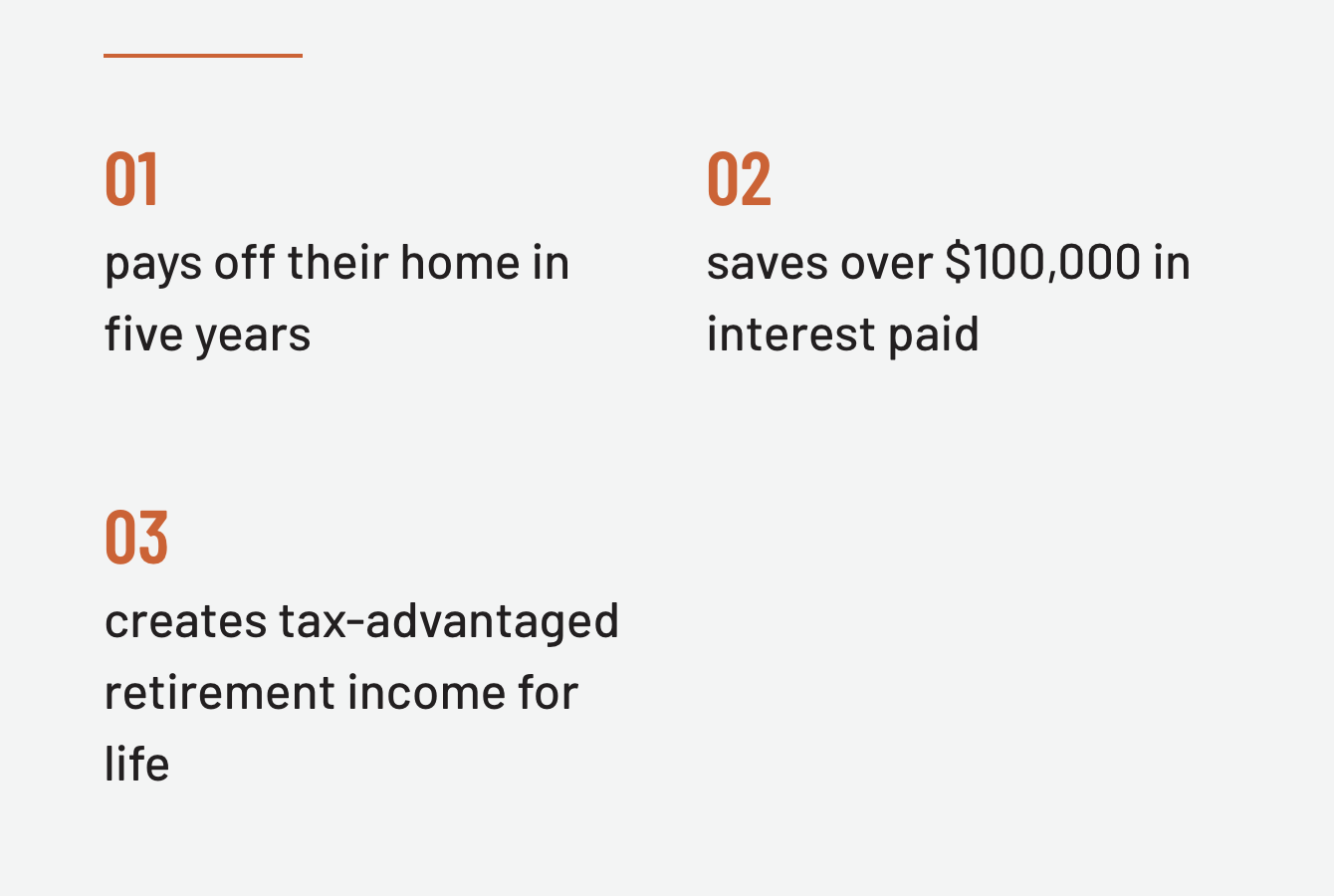
You don’t out-earn a bad structure. You replace it. Three moves:

  1. 01

    Run the numbers

    A strategist models your exact payoff month from your equity, your credit and what’s actually left over each month. If it doesn’t work in your favor, we tell you, and you keep the receipt.

  2. 02

    Flip the structure

    Your amortized mortgage is replaced with a simpler kind of debt. Every dollar you earn drives the balance down the day it lands, and your equity stays reachable instead of locked in drywall.

  3. 03

    Kill the note. Redirect the flow.

    The debt dies in years, not decades. Then the payment that used to feed the bank starts funding tax-advantaged retirement income instead.

The paperwork
burns slow.

You signed one document. It has collected every month since. Thirty years is the slowest fire there is.

Once you see it, you can’t unsee it

What clients say

“This strategy helped us cut decades off our mortgage. We’re almost debt-free and saving thousands in interest.”

Lisa T., homeowner

“Thanks to this process, we’re on track to pay off our home in five years and saving so much on interest.”

John M., homeowner

“We went from stressed to nearly mortgage-free. This approach has given us peace of mind and a secure future.”

Sarah P., homeowner

Client comments from Anchor Financial Group’s published materials. Their results are theirs, not a promise about yours.

It’s not for everyone

See if you
qualify.

Five questions. Sixty seconds. No credit pull. We score you on your equity, your credit and what’s left over each month. If it doesn’t fit, we’ll say so.

How much of your home do you actually own?

A rough guess is fine. Value minus what you owe.

Where’s your credit sitting?

Bands are enough. Nobody’s pulling anything.

In a normal month, what’s left after everything’s paid?

This is the engine. Be honest. It only has to work for you.

What do you still owe on the house?

Ballpark. It sizes the math, nothing else.

What’s the mission?

So the strategist opens with what you care about.

Where do we send your fit read?

A strategist reads every profile by hand.